Measuring Amazon with Upwave
Overview
Upwave and Amazon have a powerful integration that allows us to measure audiences automatically rather than through manually tagged media. By leveraging this integration, you'll be measuring your Amazon media in no time!
This article walks through the end-to-end setup process, including creating your Upwave campaign, configuring the corresponding Amazon DSP study, adding or removing Order ID(s), and validating common troubleshooting steps to ensure successful measurement.
Step 1: Create Upwave Campaign (if not already)
In order to measure Amazon with Upwave, you must first create your Upwave measurement dashboard, as elements from this dashboard are needed for subsequent steps.
To do this, please follow our standard Campaign Creation process (if not already).
Step 2: Create Amazon Study in Amazon DSP
Access the “Studies” Tab
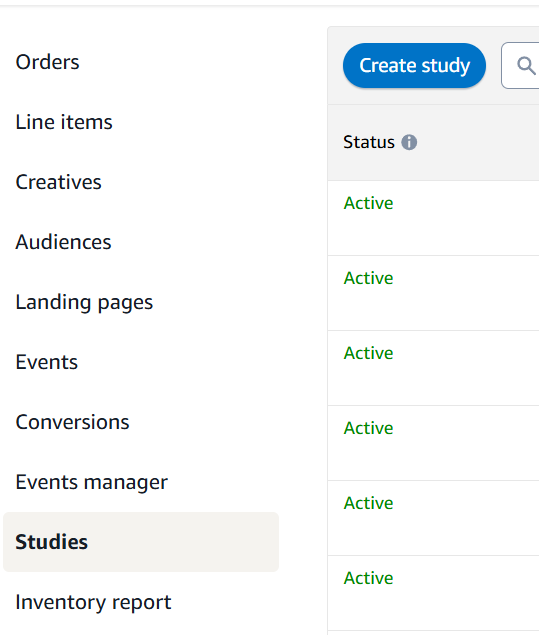
Log in to the Amazon DSP, and navigate to the "Studies" tab.
Create a Brand Lift Study
Click "Create Study":
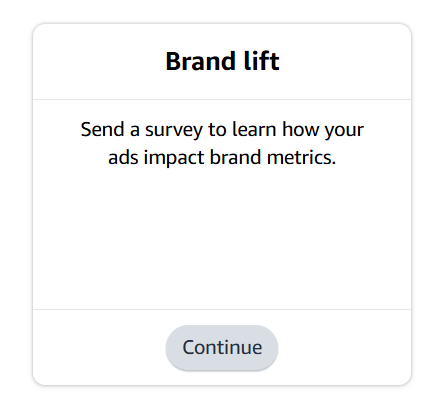
Then, select "Brand Lift" as your study type:
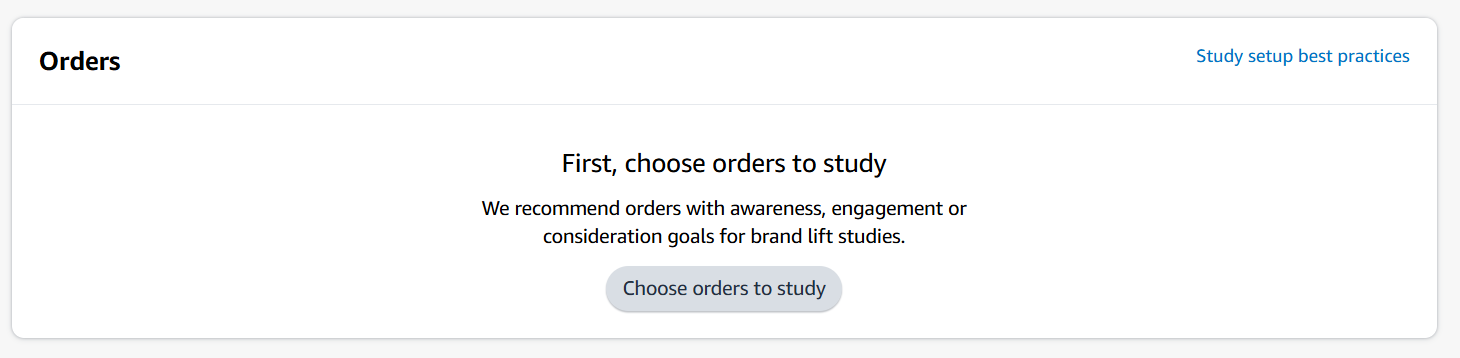
Select Media Orders
Choose the Orders that represent the media to be measured on this study:
Mark as Vendor Delivered (Advertisers)
In the “Delivered by Vendor directly” dropdown, choose "Upwave". This indicates that it is an advertiser-paid study and not Amazon-managed.
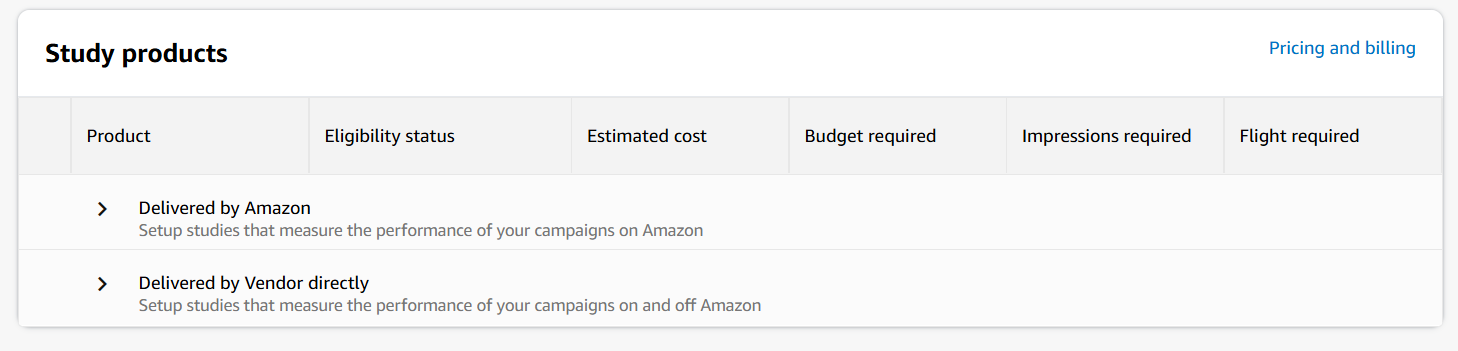
*If you don't see Upwave:
This occurs when you're working with a study targeting a geography outside the US (such as Canada). The Amazon DSP integration is currently available only for US campaigns, so Upwave will not appear under "Study Projects" for other targeted geographies.
To see the geographies Upwave supports outside of the Amazon integration, please see our Geo-Targeting FAQ.
Provide Study Details
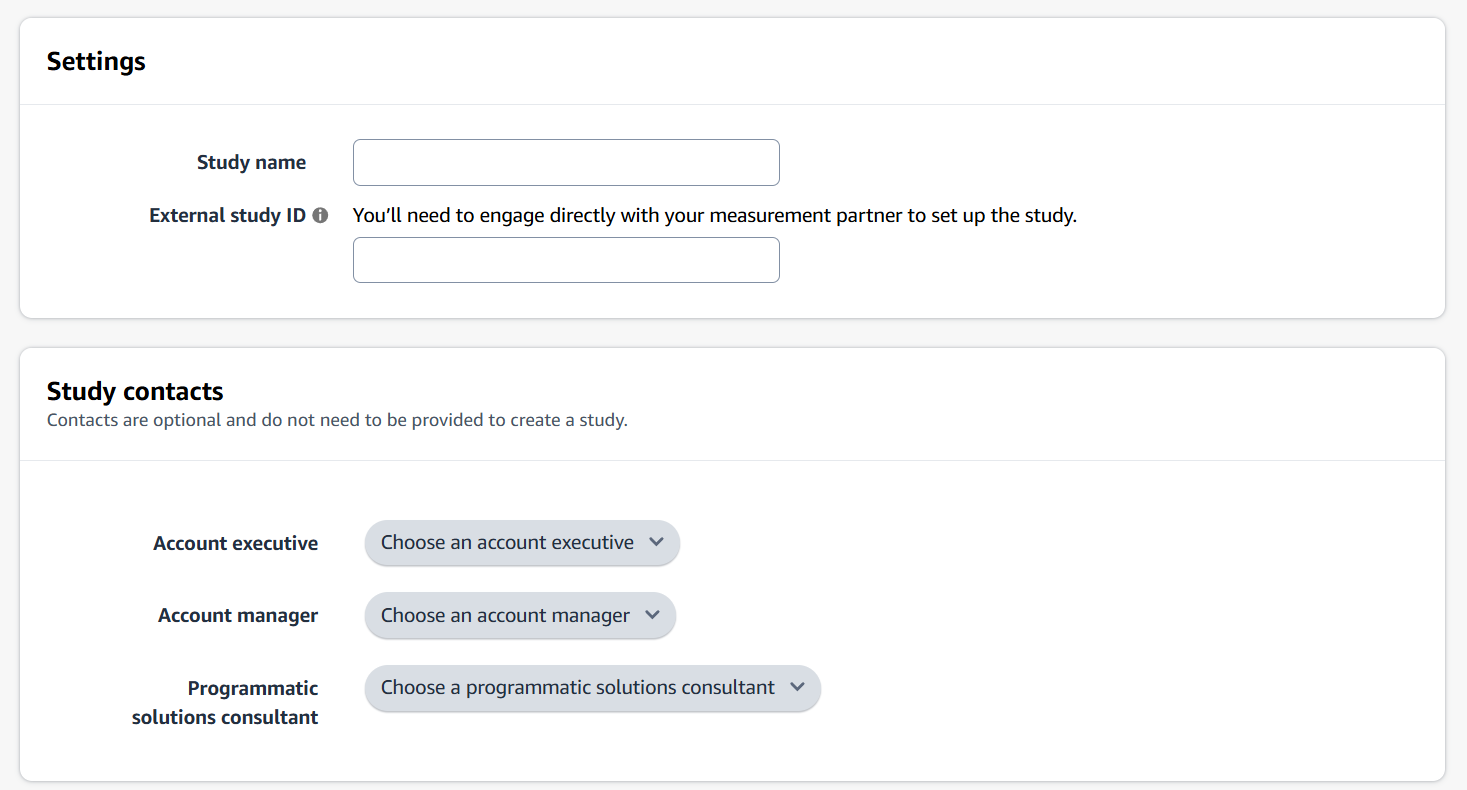
Study Name
Consider entering a unique, descriptive study name that you’ll be able to easily recognize and reference later.
Best practice is to append “ADVERTISER-PAID” to the study name.
External Study ID
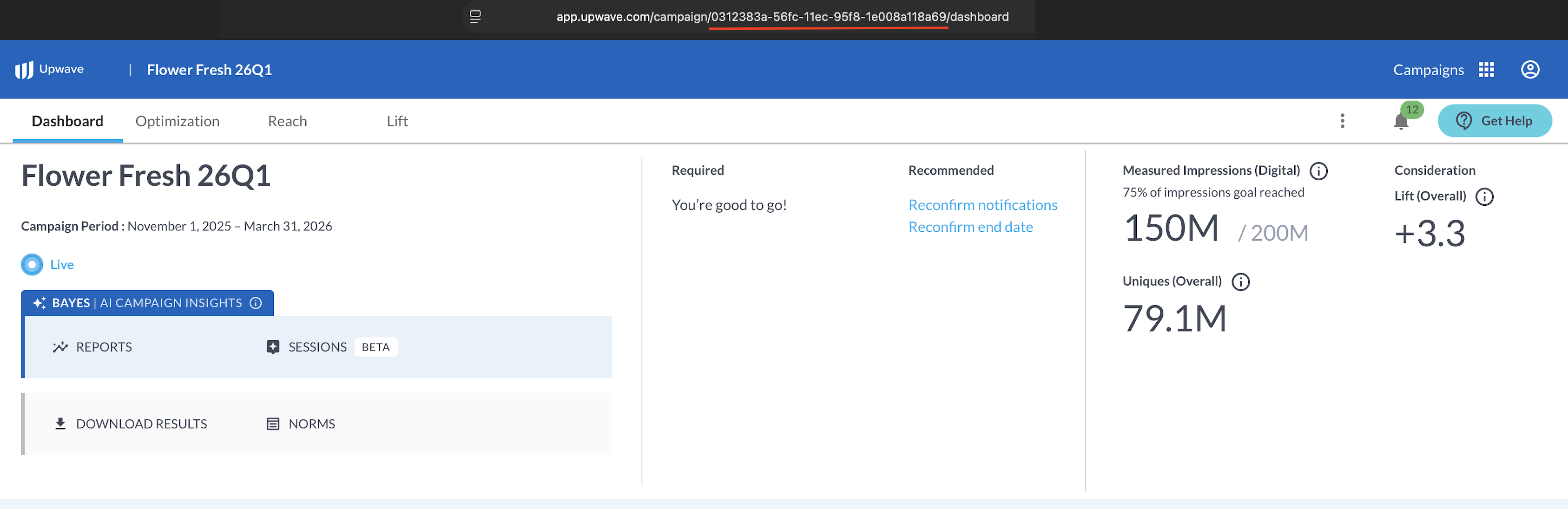
Important! The External Study ID should represent the Upwave Campaign ID in your Upwave dashboard, and is critical for knowing which Upwave campaign to associate this measurement with.
Retrieve your External Study ID by navigating to the Upwave dashboard for the campaign. The correct page will have a URL ending in “/dashboard”.
The External Study ID equals the unique identifier in that URL (as pictured below):
If you don't have access to the Upwave dashboard, please connect with someone who does so they can provide this information for you. If you're unsure who that would be, please reach out to your Upwave CSM.
Contact Information
Enter your contact information so that the appropriate teams can reach you if any coordination or follow-up is needed.
Important! Ensure a valid "Account Manager" email address is provided so they can be included if any issues are identified with your submission.
Submit
Click "Submit Study" to submit your Amazon study.
Updating Order IDs
Adding New Orders Mid-Flight
To add more Order ID(s) mid-flight, update the existing Amazon DSP study. Do not create a new Amazon DSP study.
Access the “Studies” Tab
Log in to the Amazon DSP, and navigate to the "Studies" tab.
Edit the Original Study
Find the original study that you created as part of this process.
From the Actions dropdown, select Edit.
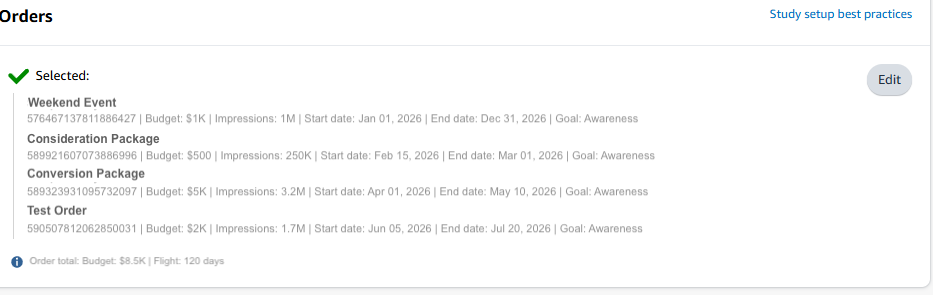
Add New Orders
Next to your list of Orders, click Edit.
Select the new Orders you would like added to the study, while ensuring the existing Orders remain selected as well (otherwise, it may appear that you are attempting to remove them).
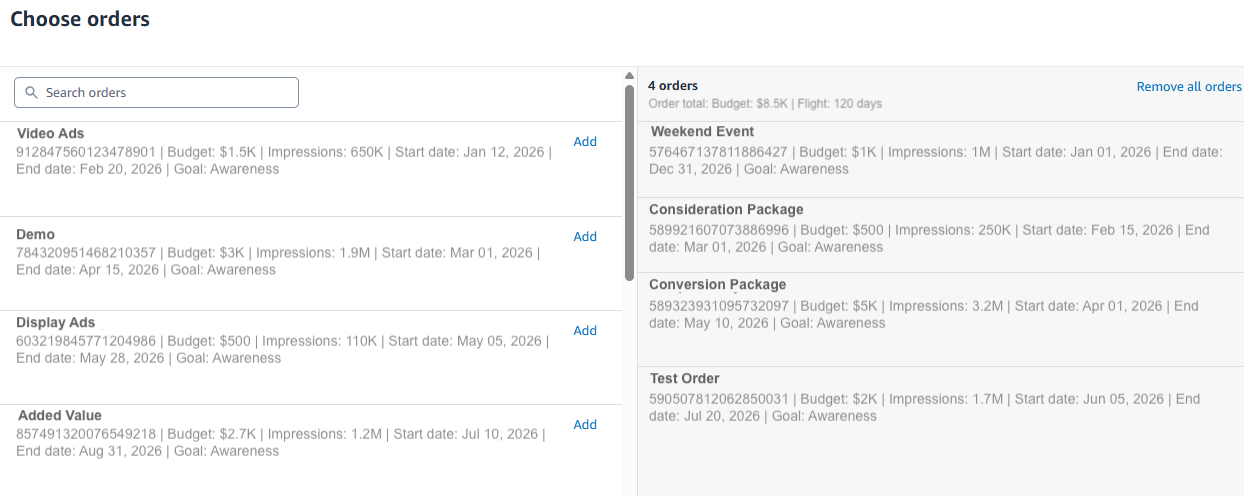
Save
Save and update the study to reflect your changes.
Removing Orders
If you believe an Order ID was submitted in error, please contact support@upwave.com or your Upwave CSM.
We will then partner with you to assess the potential impact of removing the Order ID(s), with particular focus on respondent collection and how any changes may affect results.
Troubleshooting
If the Order ID(s) you've provided don't return traffic on their expected start date(s), we will contact:
The Ad Ops contacts you designated on your Upwave Campaign Information form, and
The Account Manager designated on your Amazon DSP study, if available.
At that point, please review and confirm the following troubleshooting steps.
Confirm External Study ID
When creating your Amazon study in the Amazon DSP, was the correct External Study ID inputted?
The External Study ID should represent the Upwave Campaign ID in your Upwave dashboard, and is what tells us which Upwave campaign to associate this measurement with.
Please see instructions above for how to retrieve this ID.
Confirm Order ID(s)
Were the correct Order ID(s) selected during the "Select Media Orders" step above?
Confirm Flight Dates
Determine if the flight dates have changed since they were submitted in the Amazon DSP. If they have, please let us know.
Confirm whether media has run for the affected Order ID(s) within our default lookback window.
Amazon Tactic Mapping
After the Upwave campaign has launched, Tactic Mapping will automatically become available for live Order ID(s).
Your Tactic Mapping document will continually update as new Order ID(s) are added and/or previously submitted Order ID(s) reach their flight dates.
Those designated to receive Campaign Setup & Management notifications will receive the Tactic Mapping template once available.
Please see our FAQ for more information about Tactic Mapping.
FAQ
Amazon DSP Dates
Start/End Dates
When creating a study, the date fields are automatically populated based on the following logic:
Start Date: This is automatically determined based on the date the study is created.
End Date: This is automatically determined based on the end dates of active line items within the selected Order ID(s).
If multiple Order IDs are included: The study end date reflects the latest end date among line items with active media.
If additional Order IDs are added later:
The end date will update only if those Order IDs contain line items with scheduled media beyond the current end date.
If Order IDs don't have active line items, the end date will not extend.
Please note that Amazon DSP dates and Upwave measurement dates must both be updated, as changes in one system do not automatically update the other.
Impression Flow
Impressions are only captured if they occur within the dates mentioned above. This means:
If you extend your Upwave measurement window, you must also update the Amazon DSP study dates. Otherwise, impressions will stop flowing, even if your Upwave study remains active. If the dates are not updated in time, you may need to create a new Amazon DSP study to capture traffic beyond the original end date.
When adding Order IDs, ensure they are included in the Amazon DSP study on or before their scheduled start date. If they are added after their start date, impressions that occurred prior to being added will not be captured for measurement.
Completed Amazon DSP Studies
Once an Amazon DSP study ends, it cannot be reopened or extended. This makes it essential to keep the study’s end date updated if you're planning to extend your Upwave measurement window.
Example:
An Upwave dashboard and its associated Amazon DSP study were both scheduled to end on 12/31/2025. The advertiser later decided to extend the Upwave study into Q1 2026, but the Amazon DSP study was not updated and therefore closed as originally planned.
On 2/1/2026, the advertiser realized that while the Upwave measurement dashboard continued running, the Amazon DSP study had already ended.
To resume traffic, a new Amazon DSP study would need to be created. However, because the new study was not created until 2/1/2026, no Amazon impressions from January would be captured.
Order ID Selection
During study creation, advertisers will be prompted to select the Order IDs they want to measure.The available Order IDs are shown based on their current status in Amazon DSP:
Active Orders: Advertisers can re-select the same Order ID(s) used previously, as long as those orders are still active in Amazon DSP.
Ended Orders: Order IDs that have ended will not be available for selection.
This may look like you're trying to remove them. To avoid confusion and reduce the need to create new Amazon DSP studies, keep your DSP end dates aligned with your Upwave measurement window.
Historical measurement will not be impacted for Order IDs that are no longer selectable; Upwave will continue measuring impressions tied to previously selected Order IDs within our default lookback period. That said, impression flow stops once the Amazon DSP study ends (so new measurement will stop if those Order IDs resume, unless reselected within an active Amazon DSP study).
Funding Errors During Study Creation
In some cases, advertisers may experience the following error messaging when creating their study, "Please select a measurement fund with a sufficient balance to cover the cost of the study".

This can happen if you've created the study by cloning an Amazon-funded study, then updating it to vendor-funded.
To fix this, create a new study using the vendor-funded option from the start. This ensures the correct funding type is applied and should not produce errors.
Adaptor URLs
Amazon Adaptor URLs are no longer supported for new Amazon measurement (as Amazon is deprecating them).
Any existing measurement already leveraging Adaptor URLs is expected to continue operating as normal until ended.